
by Muhammad Budi | Fri, 23 June 2017
AMS2750 Standard: Essential Requirements for Aerospace-Grade Heat Treatment Ovens
AMS2750, titled Pyrometry, is the SAE International aerospace material specification that governs how heat treatment equipment is controlled, calibrated, and tested. It covers temperature sensors, instrumentation, thermal processing equipment, correction factors and instrument offsets, system accuracy tests, and temperature uniformity surveys. Together, these give confidence that parts and raw materials are heat treated as their process specifications require.
AMS2750 is usually invoked by customer purchase orders or by process specifications. Compliance is audited under the NADCAP heat treating accreditation program, which most major aerospace OEMs require from their suppliers.
Current Revision: AMS 2750 Rev. H* (*at the time of article writing)
The current revision is AMS2750H, published by SAE International on 15 July 2024. It supersedes AMS2750G (June 2022) and AMS2750F (June 2020). Revision H updated requirements in several areas. Heat treaters whose procedures still reference earlier revisions should check them against Revision H.
Scope
AMS2750H applies to pyrometric equipment used for the thermal processing of metallic materials. This includes furnaces, ovens, salt baths, vacuum furnaces, and refrigeration equipment used in heat treatment.
Key Requirements
1. Temperature Uniformity Surveys (TUS)
A TUS checks that temperature throughout the qualified work zone stays within the tolerance for the furnace’s class. Survey frequency depends on both the furnace class and the instrumentation type.
2. System Accuracy Tests (SAT)
A SAT compares the furnace’s control, recording, and monitoring systems against a calibrated test sensor and test instrument. It confirms that the complete measurement chain (sensor, leadwire, and instrument) reads within tolerance.
3. Instrument Calibration
Controllers, recorders, and test instruments must be calibrated at defined intervals, with calibration traceable to recognized national standards. Correction factors and offsets must be applied and documented as the specification describes.
4. Temperature Sensors (Thermocouples)
The choice between noble-metal thermocouples (Types R, S, B) and base-metal thermocouples (Types K, N, J, E, T) depends on the operating temperature and the application.
5. Documentation and Traceability
Every TUS, SAT, and calibration must be recorded in detail, and those records must be kept available for customer and Nadcap audits. Revision H tightened the requirements for instrumentation calibration records. Temperature controllers & data loggers may be subject to certain accuracy standards as per AMS2750H requirements.
Furnace Classes
AMS2750 classifies furnaces and ovens by the temperature uniformity they hold across the qualified work zone. A lower class number means a tighter tolerance.
| Furnace Class | Uniformity (°F) | Uniformity (°C) |
|---|---|---|
| 1 | ±5 | ±3 |
| 2 | ±10 | ±6 |
| 3 | ±15 | ±8 |
| 4 | ±20 | ±10 |
| 5 | ±25 | ±14 |
| 6 | ±50 | ±28 |
Instrumentation Types
AMS2750 also defines instrumentation Types A, B, C, D, D+, and E. Each type is a different combination of control, recording, over-temperature, and other requirements.
Our Offerings
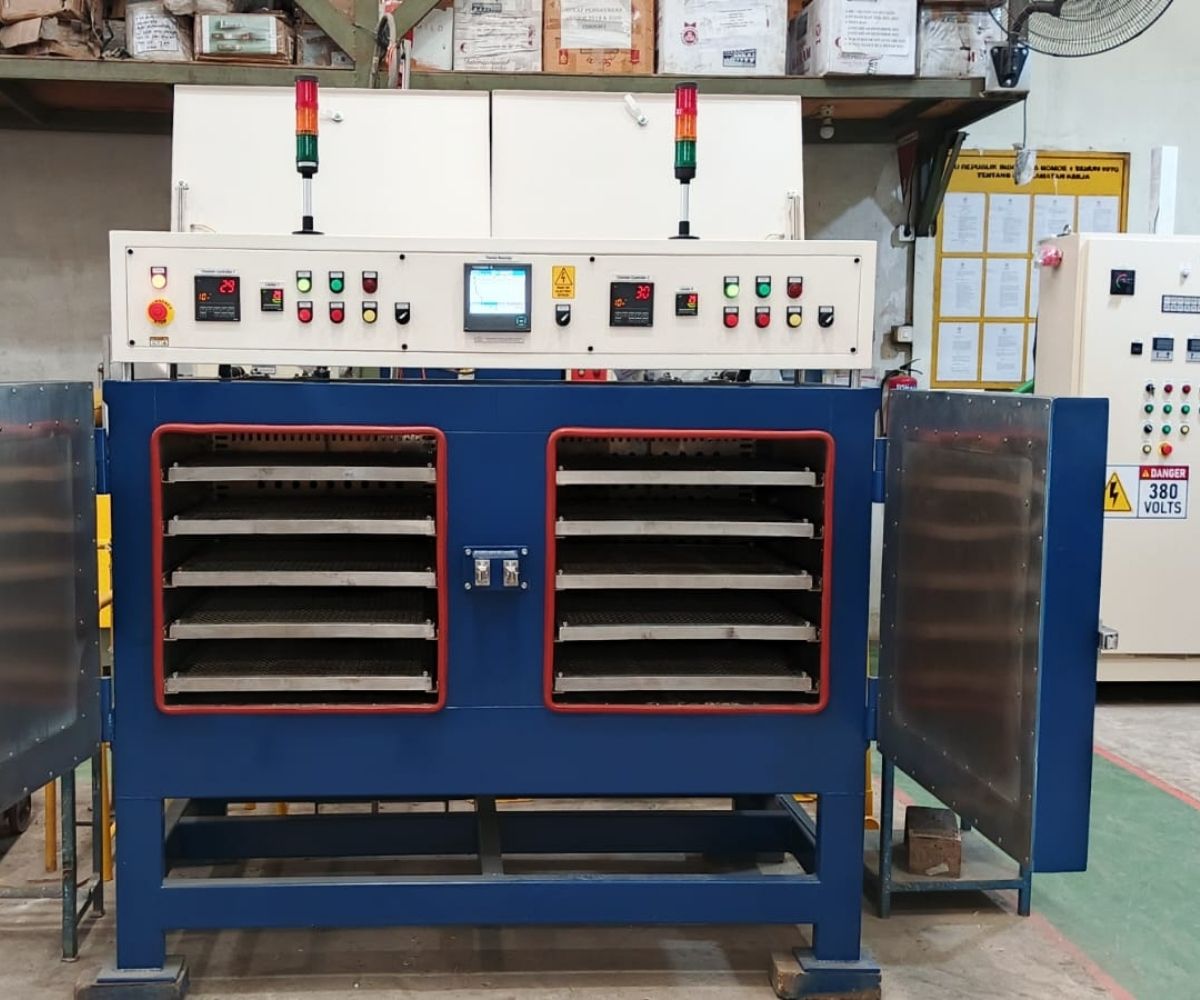
PT Suhatherm Manufacturing Indonesia designs and manufactures industrial ovens and furnaces built to meet the requirements of AMS2750H for the furnace class and instrumentation type our customers specify - up to class 1 uniformity. Shown below are ovens and furnaces we have supplied for stress relieving, electroplating hydrogen de-embrittlement process and other heat treatment processes for aerospace components.

Visit www.smindo.co.id or email cs@smindo.co.id to discuss your requirements.



PT Suhatherm Manufacturing Indonesia (SM INDO) is located in tangerang, Banten – Indonesia. We are specialist company which is engaged in the production of industrial ovens, furnaces and other heating equipment.
Copyright © 2026 PT Suhatherm Manufacturing Indonesia - All Rights Reserved.